Stocks & Financial News
Breaking financial news 24/7 courtesy of TradingCharts.com Inc. / TFC Commodity Charts
PMET Increases Grade and Scale of Caesium Mineral Resource at Shaakichiuwaanaan
Mineral Resource update includes maiden estimates at the Helios Caesium Zone and CV4 Pegmatite, contributing to overall resource growth in all three critical minerals (Li, Cs, Ta) at the Shaakichiuwaanaan Property
MONTREAL, Nov. 3, 2026 /CNW/ -- November 4, 2026 – Sydney, Australia
HIGHLIGHTS
- Significant increase in contained caesium metal (55%), grade (31%), and tonnage (18%) of the Caesium Zone MRE1, inclusive of the Vega, Rigel, and newly estimated Helios Zones.
- 1,844,000 t at 4.40% Cs2O (Indicated) – 81,200 t Cs2O in contained metal.
- 981,000 t at 3.00% Cs2O (Inferred) – 29,400 t Cs2O in contained metal.
- Already the world's largest pollucite (caesium) pegmatite, this MRE has further increased contained metal from 71,000 t to 110,600 t Cs2O.
- Additional critical mineral added to resource base with maiden rubidium (Rb) resources declared within the Caesium Zone MRE at a grade of 0.46% Rb2O (Indicated) and 0.37% Rb2O (Inferred). Rubidium is a soft, silvery-white alkali metal used primarily in scientific research, precision timekeeping, and specialized technologies.
- Consolidated MRE at Shaakichiuwaanaan confirms over 40 Mt of greater than 2% Li2O grade at CV5 and CV13 combined (indicated).
- Sensitivity analysis outlines very high-grade (Li) subsets of the resource at significant tonnage, primarily reflecting the Nova (CV5) and Vega (CV13) Zones, respectively (at 1.5% Li2O cut-off):
- 36.5 Mt at 2.04% Li2O (Indicated), 4.1 Mt at 2.01% Li2O (Inferred).
- 5.9 Mt at 2.77% Li2O (Indicated), 4.2 Mt at 2.24% Li2O (Inferred).
- 113.9 Mt at 1.43% Li2O and 164 ppm Ta2O5 (Indicated) – 4.03 Mt LCE.
- 33.8 Mt at 1.24% Li2O and 150 ppm Ta2O5 (Inferred) – 1.03 Mt LCE.
- MRE continues to re-affirm Shaakichiuwaanaan as one of the largest and highest-grade tantalum pegmatites globally.
- Sensitivity analysis outlines very high-grade (Li) subsets of the resource at significant tonnage, primarily reflecting the Nova (CV5) and Vega (CV13) Zones, respectively (at 1.5% Li2O cut-off):
______________ |
1 Mineral Resource Estimate. |
- Increase in contained LCE2 (5%) driven by combined impact of improved tonnage (4%) and grade (0.2%) of consolidated MRE at Shaakichiuwaanaan3:
- A total of 87.4 Mt (Indicated) and 2.2 Mt (Inferred) is contained within a single dyke at the CV5 Pegmatite, which is anticipated to significantly limit external dilution and simplify mining.
- Includes 1.75 Mt at 1.24% Li2O (Inferred) maiden resource at the CV4 Pegmatite, approximately 1.5 km along strike and to the east of CV5, with the gap between offering further exploration potential for additional resource growth (more drilling required).
- MRE4 update announced herein to underpin an updated Feasibility Study for Li and Ta on the CV5 Pegmatite and a Preliminary Economic Assessment for Li, Cs, and Ta on the broader Project (CV5 & CV13 Pegmatites), on schedule to be announced before year end.
Darren L. Smith – Executive Vice President of Exploration commented: "Although the 2025 drill program focused on development objectives for the Project, the work has also grown the overall resource base for all three metals, highlighted by the significant increases in the Caesium Zone MRE grade, tonnage, and contained metal.
"Shaakichiuwaanaan continues to demonstrate considerable scale in lithium, caesium, and tantalum inclusive of very high-grade subsets of the resource. Given the size of the overall resource, it is easy to forget that the scale and grade of the Nova and Vega Zones are globally significant in their own right. This is an important part of what makes the Project so unique. We are very confident there is a lot more to discover as we expand our exploration focus in future programs," added Mr. Smith.
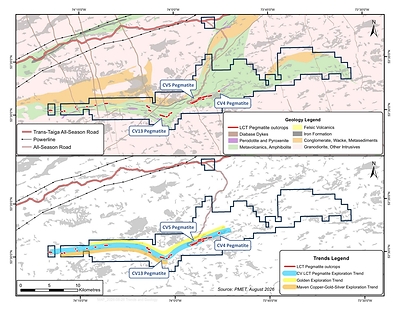
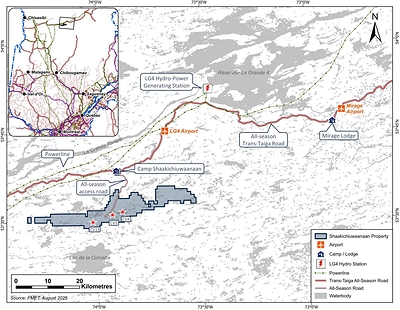
PMET RESOURCES INC. (THE "COMPANY" OR "PMET") (TSX: PMET) (ASX: PMT) (OTCQX: PMETF) (FSE: R9GA) is pleased to announce an updated Consolidated Mineral Resource Estimate ("Consolidated MRE") for its 100%-owned Shaakichiuwaanaan Property (the "Property" or "Project") located in the Eeyou Istchee James Bay region of Quebec. The Consolidated MRE, the fifth to date for the Project ("MRE-5"), includes the CV5, CV13, and CV4 lithium-caesium-tantalum ("LCT") pegmatites and is accessible by all-season road, proximal to regional hydropower infrastructure (Figure 2 and Figure 14).
________________________________ |
2 Lithium Carbonate Equivalent. |
3 Relative to the last Consolidated MRE (Effective Date of June 20, 2025). |
4 MRE announced herein (Effective Date July 10, 2026) does not materially change the current Mineral Reserve Estimate or the economic conclusions of the CV5 Lithium-Only Feasibility Study announced October 20, 2025. |
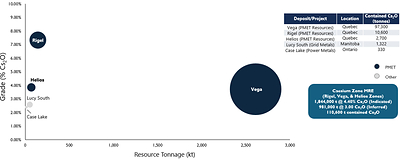
In addition to continued growth in the lithium-tantalum consolidated resource base (see below), MRE-55 has resulted in a significant increase in caesium ("Cs") resources both in terms of grade (31%), tonnage (18%), and contained metal (55%) inclusive of the Vega, Rigel, and newly estimated Helios zones (all within the CV13 Pegmatite) – 1,844,000 t at 4.40% Cs2O (Indicated) and 981,000 t at 3.00% Cs2O (Inferred) for a contained caesium content (Cs2O) of 81,200 t and 29,400 t, respectively (Table 2). This reaffirms Shaakichiuwaanaan's position as hosting the world's largest pollucite (caesium) pegmatite MRE (Figure 1).
The scale of Shaakichiuwaanaan's caesium resource is particularly significant given the supply-constrained nature of the global caesium market. Caesium formate is a premium high-density drilling fluid used in high-pressure, high-temperature (HPHT) oil and gas wells, particularly in the North Sea, with potential for broader adoption in offshore basins such as Brazil, the Gulf of Mexico, and Southeast Asia. Historically limited and highly concentrated supply has constrained wider market adoption. The emergence of a large-scale, reliable North American source of caesium could not only diversify global supply chains, but also enable the development of new caesium formate inventory pools, supporting expanded offshore exploration and greater energy security.
Additionally, a maiden rubidium ("Rb") Mineral Resource has been declared within the Caesium Zone MRE at a grade of 0.46% Rb2O (Indicated) and 0.37% Rb2O (Inferred). The target mineral for recovery for both Cs and rubidium Rb is pollucite, which is the primary host to Cs at Shaakichiuwaanaan and is the preferred source mineral for Cs globally.
________________________________ |
5 The Consolidated MRE includes the CV5, CV13, and CV4 pegmatites and is estimated at a cut-off grade of 0.40% Li2O (open-pit), 0.60% Li2O (underground CV5 and CV4), and 0.70% Li2O (underground CV13). A grade constraint of 0.50% Cs2O was used to sub-domain the Caesium Zone MRE (Rigel, Vega, & Helios Zones), contained entirely within CV13 Pegmatite, which is reported at a 0.50% Cs2O cut-off grade. The Effective Date is July 10, 2026 (through drill hole CV25-1025). Mineral Resources are not Mineral Reserves as they do not have demonstrated economic viability. Mineral Resources are inclusive of Mineral Reserves. |
The updated Consolidated MRE demonstrates continued growth in the overall resource base with increases in lithium grade (0.2%), tonnage (4%), and contained metal (5%). This includes tonnage increases at both CV5 (1.6%) and CV13 (10.4%) (Table 1):
- 113.9 Mt at 1.43% Li2O and 164 ppm Ta2O5 (Indicated) – 4.03 Mt LCE and 18.7 kt Ta2O5 contained, respectively.
- 33.8 Mt at 1.24% Li2O and 150 ppm Ta2O5 (Inferred) – 1.03 Mt LCE and 5.1 kt Ta2O5 contained, respectively.
Shaakichiuwaanaan continues to host one of the world's largest and highest-grade tantalum pegmatite MREs. Coupled with the scale and grade of the lithium and caesium resources, the tantalum provides another key differentiator for the Project.
A total of 87.4 Mt (Indicated) and 2.2 Mt (Inferred) is contained within a single principal dyke at the CV5 Pegmatite, which extends nearly 5 km in length at true widths of up to ~125 m. The scale of the resources within this single, broad dyke is significant as it is anticipated to reduce external dilution, simplify the overall mining approach, and reduce the mineral processing risk.
Additionally, MRE-5 includes maiden resources at the CV4 Pegmatite totaling 1.75 Mt at 1.24% Li2O (Inferred) and is interpreted to represent a potential 1.5 km extension of the principal CV5 Pegmatite dyke. This gap (CV5 to CV4) represents a key exploration area for future resource growth.
HIGH-GRADE NOVA AND VEGA ZONES ARE KEY DIFFERENTIATORS
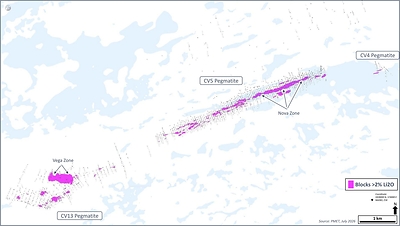
The relatively high-grade nature of the Shaakichiuwaanaan MRE, highlighted by the Nova (CV5) and Vega (CV13) Zones, is a key and powerful differentiator for the Company (Figure 5). In the MRE-5 sensitivity analysis (Table 3), significant tonnage is outlined at very high-grade (>2.00% Li2O), primarily reflecting these two zones, respectively (at 1.5% Li2O cut-off):
- 36.5 Mt at 2.04% Li2O (Indicated), 4.1 Mt at 2.01% Li2O (Inferred).
- 5.9 Mt at 2.77% Li2O (Indicated), 4.2 Mt at 2.24% Li2O (Inferred).
These zones of intense spodumene mineralization at scale (both with 10+ m drill intervals at >5% Li2O) are exceedingly rare – and potentially unique – in LCT pegmatite deposits known globally. Such scale and grade offer the opportunity to have higher-margin tonnes (potentially relatively early in the mine-life), improved recoveries, and backstop a highly robust production profile that can withstand significant downturn in the markets over prolonged periods. Collectively, these attributes lend Shaakichiuwaanaan a very defensible nature to market nuance, which is anticipated to be outlined in further detail within the updated Feasibility Study at CV5 and Preliminary Economic Assessment on the broader project (CV5 & CV13) scheduled to be announced before year end.
NEXT STEPS
MRE-5 – which includes drilling through to the end 2025 – is intended to underpin an updated Feasibility Study for Li and Ta on the CV5 Pegmatite and a Preliminary Economic Assessment for Li, Cs, and Ta on the broader Project (CV5 & CV13 Pegmatites), on schedule to be announced before year end. Drilling completed in 2026 will be incorporated into a future MRE update for the Project, anticipated in 2027.
MINERAL RESOURCE STATEMENT (NI 43-101) – MRE-5
Table 1: Consolidated Mineral Resource Statement for the Shaakichiuwaanaan Project.
Conceptual Mining Constraint | Pegmatite | Classification | Tonnes | Li2O | Ta2O5 | Ga | Contained LCE | Contained Ta2O5 |
Open-Pit | CV5 | Indicated | 98,810,000 | 1.40 | 161 | 66 | 3.42 | 15.91 |
Underground | 4,346,000 | 1.15 | 184 | 66 | 0.12 | 0.80 | ||
Total | 103,156,000 | 1.39 | 162 | 66 | 3.54 | 16.71 | ||
Open-Pit | CV5 | Inferred | 4,838,000 | 1.27 | 177 | 63 | 0.15 | 0.86 |
Underground | 9,616,000 | 1.24 | 146 | 60 | 0.30 | 1.40 | ||
Total | 14,454,000 | 1.25 | 156 | 61 | 0.45 | 2.25 | ||
Open-Pit | CV13 | Indicated | 10,533,000 | 1.86 | 181 | 75 | 0.48 | 1.91 |
Underground | 220,000 | 0.92 | 183 | 63 | 0.01 | 0.04 | ||
Total | 10,753,000 | 1.84 | 181 | 74 | 0.49 | 1.95 | ||
Open-Pit | CV13 | Inferred | 14,461,000 | 1.26 | 145 | 67 | 0.45 | 2.10 |
Underground | 3,110,000 | 1.06 | 177 | 60 | 0.08 | 0.55 | ||
Total | 17,571,000 | 1.23 | 151 | 66 | 0.53 | 2.65 | ||
Open-Pit | CV4 | Indicated | - | - | - | - | - | - |
Underground | CV4 | Inferred | 1,748,000 | 1.24 | 91 | 59 | 0.05 | 0.16 |
Total | 1,748,000 | 1.24 | 91 | 59 | 0.05 | 0.16 | ||
CV5 + CV13 + CV4 | Indicated | 113,909,000 | 1.43 | 164 | 67 | 4.03 | 18.68 | |
Inferred | 33,773,000 | 1.24 | 150 | 63 | 1.03 | 5.07 | ||
Table 2: Caesium Zone Mineral Resources within the CV13 Pegmatite.
Caesium Zone | Classification | Tonnes | Cs2O | Rb2O | Contained Cs2O |
Rigel | Indicated | 144,000 | 7.34 | 0.80 | 10,600 |
Inferred | - | - | - | - | |
Vega | Indicated | 1,633,000 | 4.19 | 0.43 | 68,400 |
Inferred | 978,000 | 2.96 | 0.37 | 29,000 | |
Helios | Indicated | 67,000 | 3.35 | 0.36 | 2,200 |
Inferred | 3,000 | 15.16 | 0.39 | 500 | |
Rigel + Vega + Helios | Indicated | 1,844,000 | 4.40 | 0.46 | 81,200 |
Inferred | 981,000 | 3.00 | 0.37 | 29,400 |
- Mineral Resources were prepared in accordance with National Instrument 43-101 – Standards for Disclosure for Mineral Projects ("NI 43-101"), the CIM Definition Standards (2014) and the JORC Code (2012). Mineral Resources that are not Mineral Reserves do not have demonstrated economic viability. This estimate of Mineral Resources may be materially affected by environmental, permitting, legal, title, taxation, sociopolitical, marketing, economic, or other relevant issues.
- The independent Competent Person (CP), as defined under JORC, and Qualified Person (QP), as defined by NI 43–101 for this resource estimate is Todd McCracken, P.Geo., Director – Mining & Geology – Central Canada, BBA Consultants. The Effective Date of the estimate is July 10, 2026 (through drill hole CV25-1025).
- Estimation was completed using a combination of inverse distance squared (ID2) and ordinary kriging (OK) for CV5 and for CV13 and inverse distance squared (ID2) for CV4 in Leapfrog Edge software with dynamic anisotropy search ellipse on specific domains.
- Drill hole composites at 1 m in length for the pegmatite domains and every 0.5 m for the caesium enriched zones (CV13). Block size is 10 m x 5 m x 5 m with sub-blocking.
- Both underground and open-pit conceptual mining shapes were applied as constraints to demonstrate reasonable prospects for eventual economic extraction. Cut-off grades for open-pit constrained resources are 0.40% Li2O for both CV5 and CV13, and for underground constrained resources are 0.60% Li2O for CV5 and CV4, and 0.70% Li2O for CV13. Open-pit and underground Mineral Resource constraints are based on a spodumene concentrate price of US$1,500/tonne (6% basis FOB Bécancour) and an exchange rate of 0.74 USD/CAD.
- The cut-off grades and mining shapes are based on Li2O (%) only. All other elements are non-paid metals and estimates are reported for reference purposes only. The Caesium Zone MRE is hosted within the CV13 Pegmatite's open-pit conceptual mining shape and sub-domained using a 0.50% Cs2O grade constraint and reported at a 0.50% Cs2O cut-off grade.
- Rounding may result in apparent summation differences between tonnes, grade, and contained metal content.
- Tonnage and grade measurements are in metric units.
- Conversion factors used: Li2O = Li x 2.153, LCE (i.e., Li2CO3) = Li2O x 2.473, Ta2O5 = Ta x 1.221, Cs2O = Cs x 1.0602, Rb2O = Rb x 1.0936.
- Densities for pegmatite blocks (CV5, CV13, & CV4) were estimated using a linear regression function (SG = 0.0674x (Li2O% + 0.81 x B2O3%) + 2.6202) derived from the specific gravity ("SG") field measurements and Li2O grade. Non-pegmatite blocks were assigned a fixed SG based on the field measurement median value of their respective lithology.
SENSITIVITY ANALYSIS
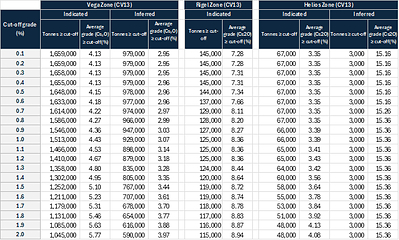
The sensitivity analysis for the Shaakichiuwaanaan Consolidated MRE and the Caesium Zone MRE are presented as the sum of the open-pit and underground constrained and classified resources at the same cut-off in Table 3 and Table 4, respectively. These tables should not be interpreted as a Mineral Resource. The data is presented to demonstrate the tonnage and grade sensitivity to various cut-off grades. Errors may occur in totals due to rounding.
Table 3: Sensitivity Analysis for Consolidated MRE Presented by Pegmatite.
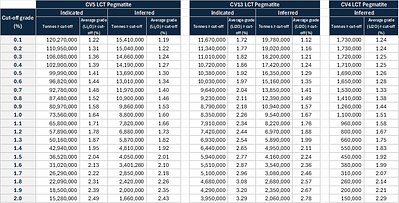
Table 4: Sensitivity Analysis for Caesium Zone MRE, hosted within the CV13 Pegmatite.
ABOUT CAESIUM
Mineral deposits of pollucite-hosted caesium are very rare globally and represent the most fractionated component of LCT pegmatite systems, which are effectively the only known primary economic source of caesium supply. Economic deposits of caesium pegmatite are typically on a smaller scale of <10 kt to 350 kt in size compared to deposits of lithium pegmatite that typically range in the millions of tonnes in size (<10 Mt to over 100 Mt).
The market for caesium compounds and metals is niche and largely opaque because it is not publicly traded like copper or gold, but rather through private bi-lateral and term contracts. Further, product prices vary depending on their contained caesium form, purity, and end-product use. As an example, caesium carbonate (Cs2CO3≥99%) as an indicative spot price currently trades at around US$250/kg (excluding VAT, Price Sourcing – Shanghai Metal Markets (SMM)6)
____________________________________ |
6 SSM publishes an indicative spot price for 99% caesium/rubidium carbonate in China. Given the small and relatively opaque nature of the global caesium and rubidium market and the limited observable transaction volumes traded on SMM, the SMM should be regarded as an indicative market reference rather than a directly achievable price for the Company's potential caesium/rubidium products. |
Caesium is currently supply constrained, with only limited sources supplying the global market. Subject to further market analysis and assessment, a discovery at the size, grade, and scale of Shaakichiuwaanaan has the potential to become a primary source of supply for global markets over the long-term7. This includes existing applications for caesium in oil/gas drilling (a non-toxic and biodegradable high-density drill fluid), medical imaging, emissions reduction, atomic clocks, and precision GPS navigation, as well as new and potentially growing applications in the terrestrial solar panel industry. Caesium has been found to play a vital role in significantly improving next generation solar panel efficiency, stability, and life span. Additionally, the use of caesium in lithium-ion batteries to improve performance is actively being explored through use as an additive in certain cathode, anode, and electrolyte chemistries.
Caesium is on the official critical minerals list of several major jurisdictions including Quebec, Canada, and the United States.
____________________________________ |
7 A Preliminary Economic Assessment on the broader Project (CV5 & CV13), inclusive of lithium, caesium, and tantalum, is anticipated to be announced before year end and will provide the first preliminary economic evaluation of caesium for the Project. |
ABOUT RUBIDIUM
Rubidium is typically recovered as a by-product in certain LCT pegmatite processing circuits from pollucite and/or lepidolite minerals. At Shaakichiuwaanaan, the rubidium of interest is contained within pollucite (and associated subordinate lepidolite) specifically within the Caesium Zone MRE.
Rubidium is a soft, silvery-white alkali metal used primarily in scientific research, precision timekeeping, and specialized technologies. It is used in atomic clocks and precision GPS navigation, medical and biomedical applications, quantum technologies, and specialized electronic components. The market for rubidium is similar to caesium in that it is niche, opaque, and dominated by private sales. As an indicative example, prices for rubidium carbonate (Rb2CO3≥99%) in the spot market currently trade around US$1,100/kg (excluding VAT, Price Sourcing – Shanghai Metal Markets (SMM)6). Rubidium is on the official critical minerals lists of major jurisdictions such as the United States and Japan.
GEOLOGICAL AND BLOCK MODELS (MRE-5)
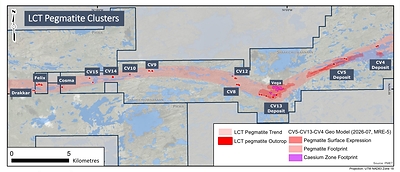
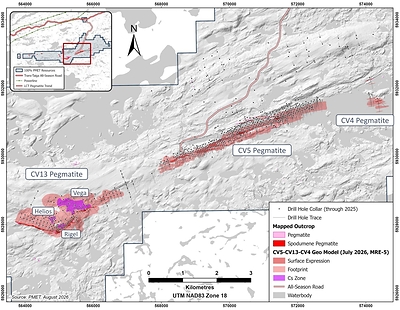
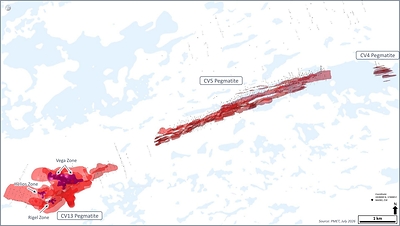
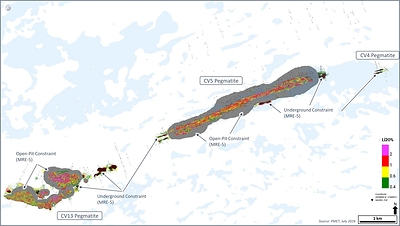
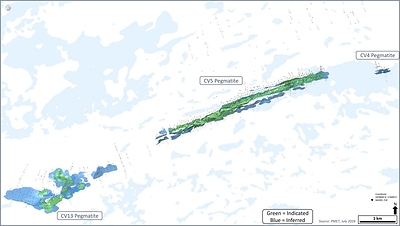
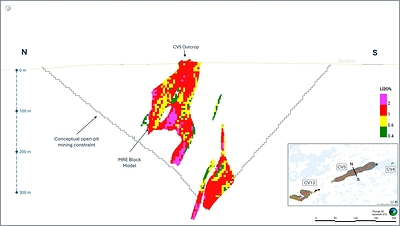
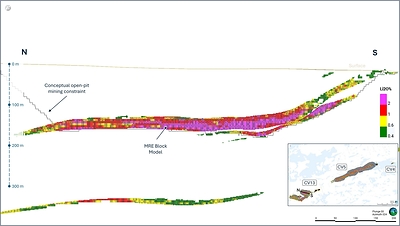
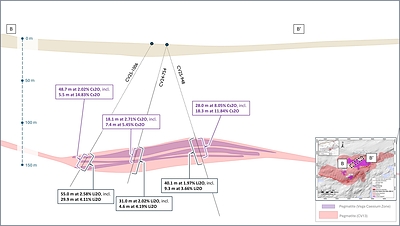
The geological models underpinning MRE-5 include the CV5, CV13, and CV4 LCT pegmatite clusters (Figure 3). Each cluster consists of a series of pegmatite dykes (remaining open in multiple directions) that range in orientation from near flat-lying at CV13 to near-vertical at CV5 and CV4. The dyke's range in true thickness from <5 m to upwards of 125 m with the largest dyke (the "principal" dyke at CV5) representing approximately 60% of the total consolidated resource tonnage.
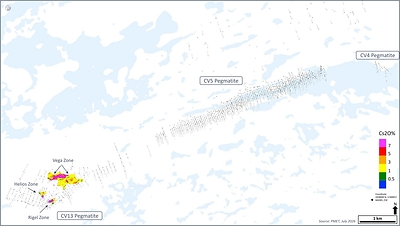
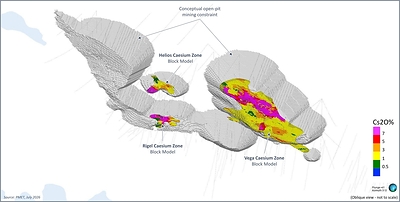
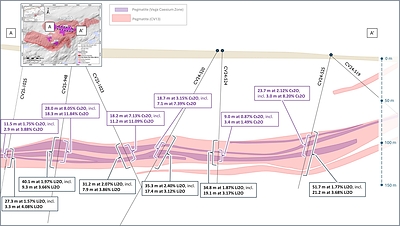
The Caesium Zone MRE is hosted within the CV13 Pegmatite and geologically sub-domained using a 0.50% Cs2O grade constraint. These domains (Rigel, Vega, Helios) act as hard boundaries within the wider CV13 Pegmatite geological model for subsequent block modelling and resource estimation at a 0.50% Cs2O cut-off grade.
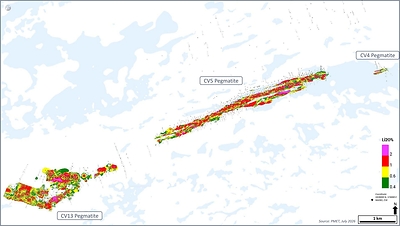
The geological and block models, classifications, and sections reflecting the Consolidated MRE and the Caesium Zone MRE are presented in Figure 4 to Figure 13.
ASX LISTING RULE 5.8
As the Company is listed on both the Toronto Stock Exchange (the "TSX") as well as the Australian Securities Exchange (the "ASX"), there are two applicable regulatory bodies resulting in additional disclosure requirements. This MRE has been completed in accordance with the Canadian National Instrument 43-101 – Standards of Disclosure for Mineral Projects. Additionally, in accordance with ASX Listing Rule 5.8 and the JORC 2012 reporting guidelines, a summary of the material information used to estimate the Mineral Resource for CV5, CV13, and CV4 (including the Rigel, Vega, and Helios caesium zones) at the Shaakichiuwaanaan Project is detailed below. For additional information, please refer to JORC Table 1, Section 1, 2, and 3, as presented in Appendix 1 of this announcement.
MINERAL TITLE
The Shaakichiuwaanaan Property is located approximately 220 km east of Radisson, QC, and 240 km north-northeast of Nemaska, QC. The Property consists of two primary claim groups, one straddling KM-270 of the Trans-Taiga Road and the other with its northern border located directly south of KM-270, approximately 6 km from the Trans-Taiga Road and powerline infrastructure corridor (Figure 14). The La Grande 4 (LG-4) hydroelectric dam complex is located approximately 30 km north-northeast of the Property. The CV5 LCT Pegmatite is located central to the Property, approximately 13 km south of KM-270 on the Trans-Taiga Road, 14 km south of the powerline, and 50 km southwest of the LG-4 dam complex. The CV13 LCT Pegmatite is located <1.5 km west-southwest of CV5. The CV4 LCT Pegmatite is located ~1.5 km along geological trend to the east of the CV5 Pegmatite.
The Property is comprised of 463 Exclusive Exploration Rights ("EER") (formerly known as CDC mineral claims) that cover an area of approximately 23,710 ha. All claims are registered 100% in the name of Lithium Innova Inc., a wholly owned subsidiary of PMET Resources Inc.
GEOLOGY AND GEOLOGICAL INTERPRETATION
The Property overlies a large portion of the Lac Guyer Greenstone Belt, considered part of the larger La Grande River Greenstone Belt, and is dominated by volcanic rocks metamorphosed to amphibolite facies. Rocks of the Guyer Group (amphibolite, iron formation, intermediate to mafic volcanics, peridotite, pyroxenite, komatiite, as well as felsic volcanics) predominantly underly the Property (Figure 15). The amphibolite rocks that trend east-west (generally steeply south dipping) through this region are bordered to the north by the Magin Formation (conglomerate and wacke) and to the south by an assemblage of tonalite, granodiorite, and diorite, in addition to metasediments of the Marbot Group (conglomerate, wacke). Several regional scale Proterozoic gabbroic dykes also cut through portions of the Property (Lac Spirt Dykes, Senneterre Dykes). The KCG claim block, located to the north of the principal claim group, is situated within the Bezier Suite (monzodiorite and granodiorite), and outside the Guyer Group.
At the Property, mineralization is observed to occur within lithium-caesium-tantalum ("LCT") pegmatites, hosted predominantly within amphibolite, metasediment, and ultramafic rocks of the Guyer Group within the principal claim group. The LCT Pegmatite Trend is currently recognized as an approximate 1-km wide and 25+ km long corridor, which is host to numerous distinct LCT pegmatite occurrences, and extends in a general east-west direction across the central and western portions of the Property. The LCT pegmatites along this trend may outcrop as isolated high-relief 'whale-back' landforms or relatively low-relief to flat landforms.
To date, eleven (11) distinct LCT pegmatite clusters have been discovered along this trend at the Property: CV4, CV5, CV8, CV9, CV10, CV12, CV13, CV14, CV15, Felix, and Cosma (Figure 16). The dominant lithium-bearing mineral is spodumene (typically decimetre to metre scale), with no significant contribution from other minerals, and the dominant tantalum-bearing mineral is tantalite (±columbite).
Of these clusters, CV5, CV12, CV13, and Cosma have confirmed pollucite-hosted caesium mineralization. Pollucite is an extremely rare mineral occurrence in LCT pegmatites and represents the most fractionated components of the system.